
Student Retention Strategies in Higher Education: From Classroom Insights to Action

A missed class can have many explanations. A student may be ill, working an extra shift, struggling with transport, or finding the course difficult. A change in participation can be equally ambiguous. The useful question for an institution is what support the student might need—and how to make that conversation happen.
Student retention strategies in higher education need to connect institutional support with students’ actual experiences. Classroom information can contribute to that work when educators have a clear process for reviewing it, asking questions, and following up.
For academic leaders and program teams, a practical starting point is to:
- Make transition and first-year support easy to access.
- Strengthen connections with faculty and peers.
- Collect student feedback and respond to it.
- Connect students with academic, financial, and personal support.
- Review classroom information regularly and assign follow-up.
Below, we connect these priorities to research and provide a weekly review template your team can adapt.
What is student retention?
Student retention generally concerns whether students continue their studies at an institution across a defined period. When reporting a retention rate, specify the cohort and interval—for example, first-year students returning the following academic year. Completion and graduation measure related outcomes over a longer period.
For academic teams, retention work involves understanding the conditions that help students continue and addressing barriers that interrupt their studies. Attendance, participation, and course feedback provide information about parts of the student experience. They do not, individually, establish whether someone will remain enrolled.
What does research tell us about retention?
Gonçalves et al. (2024) analysed 125 articles published between 2014 and 2022 using bibliometric methods and a review of the literature. They identified three research streams: institutional activities aimed at retention, institutional activities supporting student success, and students’ perspectives on persistence. [1]
The review brings together work on academic support, financial difficulties, motivation, interactions with faculty and peers, and institutional experiences. Its central implication for practice is that retention requires a coordinated response to different student needs.
The authors also highlight the importance of context. An approach appropriate for one institution or student population may need adapting elsewhere. Their review maps research and proposed activities; it does not establish a universal ranking of interventions or establish the effect of a particular software product. Most of the research reviewed concerns US institutions, with some European representation; Canadian teams should consider their own student populations and institutional setting. [1]
Five student retention strategies for academic teams
1. Make the transition into higher education easier
The review identifies transition and first-year support as recurring themes. Examples include introductory programs, academic advising, and support for students taking challenging courses. [1]
An institution can translate this into clear, practical questions: Do new students know where to ask for help? Can they access support around their timetable? Do instructors know how to refer a student? Review those arrangements beyond the first year as students’ needs change.
Start here: Ask a small group of new and returning students to explain how they would get help with a difficult course. Use the gaps they identify to improve the support route.
2. Strengthen connections with faculty and peers
Interactions with teachers and peers are prominent in the research reviewed by Gonçalves and colleagues. [1] For a program team, this makes the everyday learning environment a useful area for attention.
Consider opportunities for students to ask questions, work with others, and speak with instructors. McGill’s program-design guidance includes first-year seminars and shared learning experiences among approaches intended to support student development, engagement, and retention. [2]
3. Listen to students and explain what changes
Feedback can help a teaching team understand experiences that attendance records cannot explain. Questions about pace, clarity, workload, or access to learning materials can make the next conversation more specific.
As a practical approach, choose a manageable feedback routine and close the loop: explain what the team heard, what it can change, and what needs further discussion. Try a focused prompt: “What is making it harder to keep up with this class, and what would help next week?” Share a short response with the class once you have reviewed the answers.
Anonymous feedback can inform a response at class level. It should not be used to attribute a concern to an identifiable student.
4. Connect academic concerns with wider support
The review includes financial and personal difficulties alongside academic factors. [1] A useful retention process therefore needs referral routes to the appropriate services, such as academic advising, financial support, accessibility services, or wellbeing support.
Give staff a clear point of contact and agree who follows up. Students should understand the next step and know whom to approach if the first referral does not resolve their concern.
5. Review classroom information and assign follow-up
Attendance patterns can help educators notice when a check-in may be useful. Cornell’s Center for Teaching Innovation explains that tracking attendance and participation can alert instructors when students are not attending or participating and allow them to reach out sooner. [3]
Interpret those patterns in context. A timetable change, inaccessible activity, or temporary illness can affect attendance. Participation also takes different forms: speaking aloud is only one way a student can engage.
Yale’s teaching guidance recommends explaining how attendance information supports students and building flexibility into attendance policies. [4] This provides a useful foundation for follow-up: approach a change with curiosity and an offer of help.
Keep class-level feedback and individual attendance records distinct. A class may report difficulty understanding a topic, while a particular student may miss sessions for an unrelated reason. Together, these observations can inform questions; they do not establish a shared cause.
A practical weekly review process
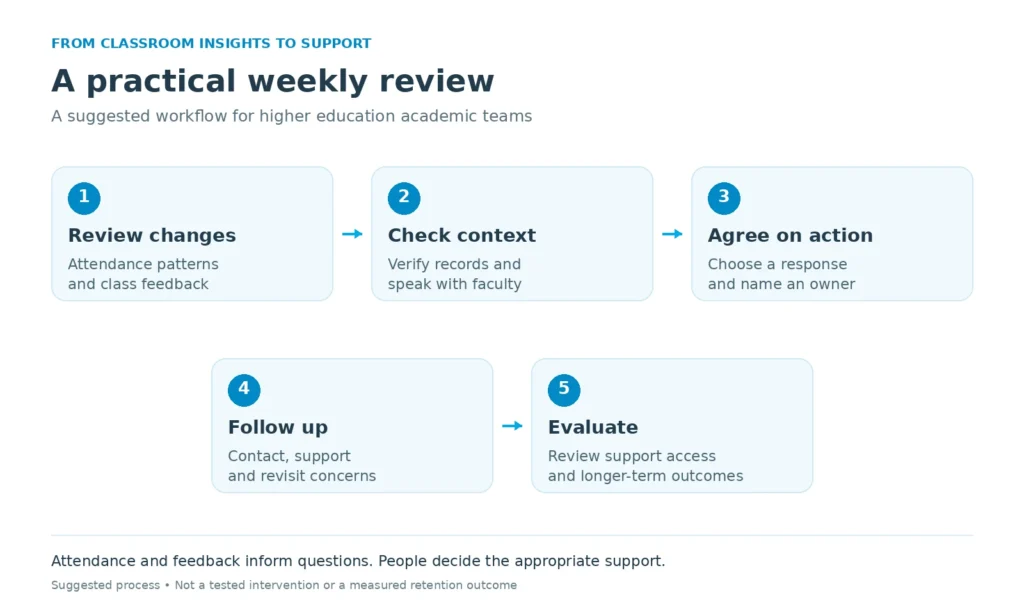
The workflow below is a practical starting point we propose for academic teams. Adapt the frequency and responsibilities to your institution; the research review did not test this specific process.
1. Review changes. Look at attendance patterns and available class feedback over a suitable period. Check the number of responses behind feedback summaries; a small response count may give an incomplete picture.
2. Check the context. Ask the instructor about recent assessments, timetable changes, teaching activities, and other circumstances. Confirm that the underlying records are complete before drawing conclusions.
3. Agree on an action and an owner. A class-wide concern may warrant a clarification session or revised learning material. An individual attendance concern may warrant a private, supportive check-in. Assign responsibility and a follow-up date.
4. Follow up. Check whether the action happened and whether the student or class found it helpful. Record relevant follow-up through the institution’s approved processes.
5. Evaluate over time. Review whether support reaches students and whether problems are resolved. Assess retention separately using a consistent cohort and reporting period. An improvement in weekly attendance alone does not demonstrate an improvement in retention.
A weekly review template your team can use
Use one row per issue in your institution’s approved record system. Keep individual student information within authorized access arrangements.
| Observation | Question to check | Possible response | Owner | Follow-up |
|---|---|---|---|---|
| Repeated absences in an individual record | Are the records complete, and has the student explained a barrier? | Private check-in and appropriate referral | Instructor or designated advisor | Agreed date and referral status |
| Class feedback raises concerns about pace | How many students responded, and which topics were difficult? | Recap, worked example, or clarification | Instructor | Ask whether the adjustment helped |
| Several classes raise similar workload concerns | Are assessment deadlines clustered? | Review scheduling with the relevant faculty | Program lead | Review the next assessment period |
These are suggested responses to investigate, not automatic rules for labelling students at risk. Your team can maintain action ownership and referral records in its existing systems; this template does not imply an AtKlass case-management feature.
An illustrative example
Imagine that attendance falls across several sessions of an introductory course. Separately, anonymous feedback suggests that some respondents are struggling with the pace.
The program lead discusses both observations with the instructor. They check the timetable and records, then agree to offer a recap and invite further questions. The instructor also contacts students with repeated absences privately to ask whether support would help, without assuming they submitted the feedback.
At the next review, the team checks participation in the recap, new feedback, and the status of any referrals. This is a hypothetical scenario, not a measured customer outcome.
How AtKlass supports your student retention strategy
AtKlass connects attendance records, student feedback, and reporting with the day-to-day work of academic teams. Here is how those capabilities can support the review and follow-up process described above.
Review attendance patterns and follow up with context
AtKlass student attendance software provides individual attendance history, class and course summaries, and institution-level reports. Weekly attendance trends and the Active Learners and Need Attention lists help staff decide which records warrant a closer look.
Reports can identify students with significant absences, and AtKlass supports direct email communication for follow-up. An instructor can review missed sessions before contacting a student to ask what support may help. A Need Attention label is a prompt to investigate; it does not explain the absence or predict that a student will leave.
Understand the student experience behind the numbers
With AtKlass classroom engagement tools, students can submit anonymous comments, rate their class experience, share live reactions, and answer instructor-created polls. These provide different ways to hear how students experience a session.
For example, an instructor can use a poll to ask which topic needs another explanation, then review later feedback after revisiting it. Ratings should be read alongside response counts and comments: they reflect reported experience rather than a direct measure of learning. Anonymous feedback remains class-level context, not evidence about an identified student’s circumstances.
Use weekly reports for regular review
AtKlass provides weekly reports with attendance and class-rating information, including the number of ratings received. Instructors can review trends and compare their own classes. An overall benchmark provides context relative to other classes without exposing those classes’ detailed results.
AtKlass also emails monthly reports that include attendance information and class ratings. Weekly reporting and monthly emailed summaries offer different review intervals; teams can use them alongside dashboard information to prepare conversations and revisit concerns.
Give faculty and administrators the appropriate view
Instructors work with their own classes, while administrators can review reports across the institution according to their access permissions. Professors can import class lists from D2L or Blackboard or use a file upload to get started.
These tools support information gathering, review, and communication within a wider retention strategy. Academic teams still decide what support is appropriate, coordinate referrals, and evaluate outcomes over time.
Start with one program and a clear follow-up process
Choose a program, agree who reviews the information, and decide where actions will be recorded. Track whether follow-up happens and whether students can access the support offered. Compare retention over a consistent cohort and period rather than treating attendance changes as a retention result.
Explore how attendance records and student feedback can support your academic team with AtKlass for higher education.
References
- Gonçalves, G. S., Serra, F. A. R., Storopoli, J. E., Scafuto, I. C., & Rafael, D. N. (2024). Undergraduate Student Retention Activities: Challenges and Research Agenda. SAGE Open, 14(3). https://doi.org/10.1177/21582440241249334
- McGill University. Program design strategies. https://www.mcgill.ca/teaching-academic-programs/units/program-design-strategies
- Cornell University, Center for Teaching Innovation. Assessing Class Attendance and Participation. https://teaching.cornell.edu/teaching-resources/assessing-student-learning/assessing-class-attendance-and-participation
- Yale University, Poorvu Center for Teaching and Learning. Attendance Policies to Support Student Learning. https://poorvucenter.yale.edu/teaching/teaching-resource-library/attendance-policies-to-support-student-learning